U.S.-Venezuela Relations Since the 1990s by Corrales Javier Romero Carlos A. & Carlos A. Romero
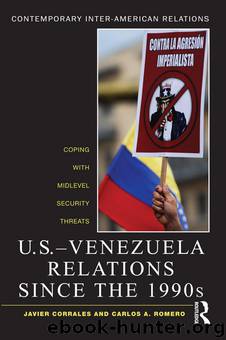
Author:Corrales, Javier,Romero, Carlos A. & Carlos A. Romero [Javier Corrales]
Language: eng
Format: epub
ISBN: 9781136622175
Publisher: Taylor & Francis (CAM)
Breaking with History and the Majority
The rise of soft balancing policies, social power diplomacy, and close ties with rogue states represents a significant break with the past in Venezuela. This change has occurred not necessarily at the level of activism itself, but at the level of aims.
International relations (IR) experts who study Venezuela agree that between 1958 and 1998, the Venezuelan state displayed a fairly active foreign policy, always fueled by oil revenues. This did not change under Chávez, except in its degree. That is, Venezuela’s foreign policy under Chávez did not go from passive to active, but rather, from active to perhaps hyperactive.
The real departure in foreign policy can be seen in its objectives (Romero and Corrales 2010). Historically, through aid and institution-building initiatives, Venezuela’s foreign policy aimed at promoting democratic movements and governments, especially those fighting against or emerging from right-wing dictatorships. In some cases, these foreign policy preferences meant that Venezuelan presidents played subversive roles, as when President Betancourt supported the opposition to Trujillo in the Dominican Republic, or when President Pérez in the 1970s supported the revolution against Somoza in Nicaragua. In other less subversive endeavors, Venezuela often collaborated with the United States on democracy-promotion initiatives in the hemisphere. Under Chávez, however, Venezuela started placing emphasis on ties with nondemocracies. And instead of promoting democratic groups fighting authoritarian governments, Chávez started to support (with money, alliance networks, and advice) only those movements and governments with a certain ideological bent, namely those that were interested in fighting capitalism, pluralist political parties, and institutions of checks and balances (e.g., Evo Morales’s MAS party in Bolivia and Rafael Correa’s PAIS party in Ecuador), or those that refrained from criticizing Venezuela (e.g., Néstor Kirchner and Cristina Fernández’s Peronist faction in Argentina).
Chávez’s foreign policy represents a break not just from the past but also from majority opinion. This is evident in polls conducted by both international and local pollsters. A famous international study of attitudes toward global powers in 47 countries indicated that 56 percent of Venezuelans in 2007 expressed having “a positive image” of the United States (Kohut, Wike, and Horowitz 2007). This level of “sympathy” toward the United States is similar to those found across close U.S. allies in the hemisphere such as Canada, Mexico, and Chile (see Figure 6.1). Furthermore, Venezuela has one of the world’s highest numbers of respondents with “favorable views” of U.S. cultural exports (see Table 6.1). In short, Venezuelans might not be as overwhelmingly pro-U.S. as many Africans, but the majority is certainly not as anti-U.S. as the Venezuelan government.
Download
This site does not store any files on its server. We only index and link to content provided by other sites. Please contact the content providers to delete copyright contents if any and email us, we'll remove relevant links or contents immediately.
| Anthropology | Archaeology |
| Philosophy | Politics & Government |
| Social Sciences | Sociology |
| Women's Studies |
The Secret History by Donna Tartt(19470)
The Social Justice Warrior Handbook by Lisa De Pasquale(12293)
Thirteen Reasons Why by Jay Asher(9120)
This Is How You Lose Her by Junot Diaz(7057)
Weapons of Math Destruction by Cathy O'Neil(6468)
Zero to One by Peter Thiel(5952)
Beartown by Fredrik Backman(5939)
The Myth of the Strong Leader by Archie Brown(5625)
The Fire Next Time by James Baldwin(5586)
How Democracies Die by Steven Levitsky & Daniel Ziblatt(5322)
Promise Me, Dad by Joe Biden(5229)
Stone's Rules by Roger Stone(5190)
A Higher Loyalty: Truth, Lies, and Leadership by James Comey(5089)
100 Deadly Skills by Clint Emerson(5023)
Rise and Kill First by Ronen Bergman(4891)
Secrecy World by Jake Bernstein(4885)
The David Icke Guide to the Global Conspiracy (and how to end it) by David Icke(4850)
The Doomsday Machine by Daniel Ellsberg(4622)
The Farm by Tom Rob Smith(4611)
